Let's say you've done everything right from an SEO perspective.
You've spent months on keyword research; your blog ranks on Google for terms like "email marketing tools," "best CRM for startups," and "AI tools for marketers." Your traffic is decent, your backlinks are growing, and you're starting to appear in industry roundups.
Then a potential customer opens ChatGPT and asks:
"What are the best tools for email marketing?"
Your biggest competitors appear, but your brand doesn't. You run the same query on Perplexity and Google AI Overviews, and the results are similar: competitors get mentioned and cited, while your brand is missing.
You rank on Google, but AI-powered search isn't surfacing your brand.
This is not an isolated scenario. In an April 2026 study, EMGI tested 150 SaaS companies across 120 keywords and found that 44% of brands ranking in Google's top 10 were completely invisible to ChatGPT.
By early 2026, only 17–38% of AI Overview citations came from Google's top 10 organic results, down from 76% in mid-2025, according to separate research from Ahrefs and BrightEdge.
AI-powered search has changed how people discover information. ChatGPT, Perplexity, and Google AI Overviews don't simply reproduce Google's search rankings. They draw on a wider range of signals, including brand recognition, citation frequency, topical authority, and structured content, to determine which sources and businesses appear in their answers.
Marketers are responding to this shift. According to Conductor research reported by MarTech in February 2026, 12% of digital marketing budgets in 2025 had already been allocated to Generative Engine Optimization (GEO) initiatives, while 94% of marketers planned to increase their AEO/GEO investment in 2026, outpacing planned investment growth in paid channels.
In this article, I’ll explore what GEO is, why it matters, and the practical steps marketers can take to improve their chances of appearing in AI-generated answers, alongside their traditional search performance.
What is GEO, and why are marketers paying attention now?
Generative Engine Optimization (GEO) is the practice of structuring your content and building your brand's presence across the web so that AI-powered search platforms can discover your business, understand what you offer, and reference your brand when generating answers.
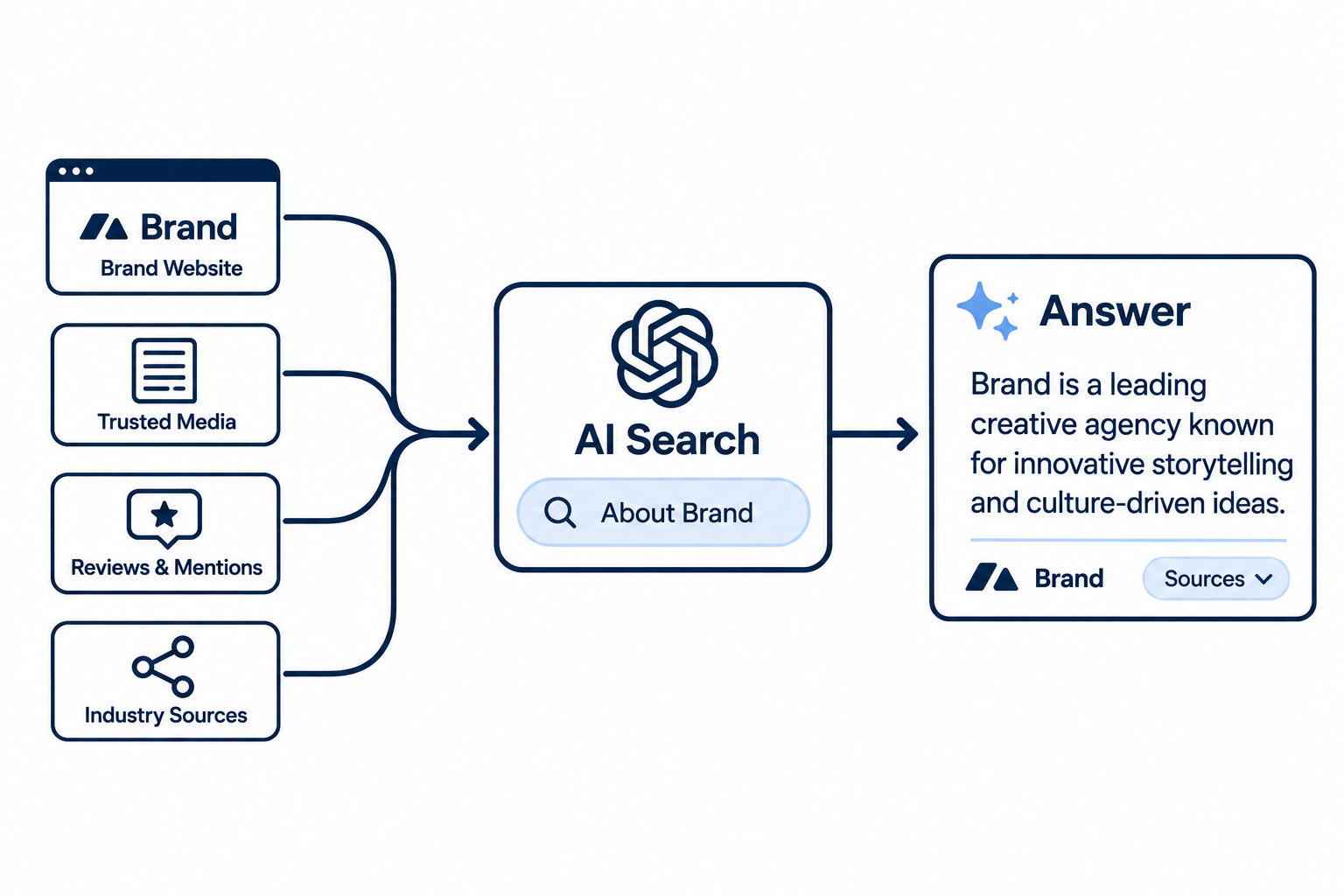
AI search flowchart
Traditional SEO focuses on improving a website's position in search engine results. GEO focuses on making a brand a credible, referenceable source that AI platforms can include in their generated responses, regardless of whether its website ranks first in traditional search.
This explains why ranking on Google no longer guarantees that your brand will appear in ChatGPT, Perplexity, or Google AI Overviews. Marketers need to think beyond individual keyword rankings and consider how their brands are represented across the wider web.
Many discussions about GEO jump straight to technical fixes such as schema markup, structured data, and hreflang tags. These are important, but the underlying challenge is often recognition.
AI platforms need consistent information about what your brand does, who it serves, and why it is credible. If different sources describe your business in conflicting ways, it becomes harder to establish a clear association between your brand and the topics you want to be known for.
Consider a Nigerian fintech brand that publishes content about payment infrastructure, personal finance, and cryptocurrency. Across the web, different sources describe it in different ways. One industry roundup calls it a payments app. Another describes it as a savings tool. A third mentions it in a cryptocurrency context.
When an AI platform encounters these different descriptions, it has no single, consistent picture of the brand's core offering. This makes it harder to associate the business confidently with a specific search query.
GEO addresses this challenge by building clearer, more consistent signals across the platforms where your brand appears.
SEO vs GEO: What's the difference?
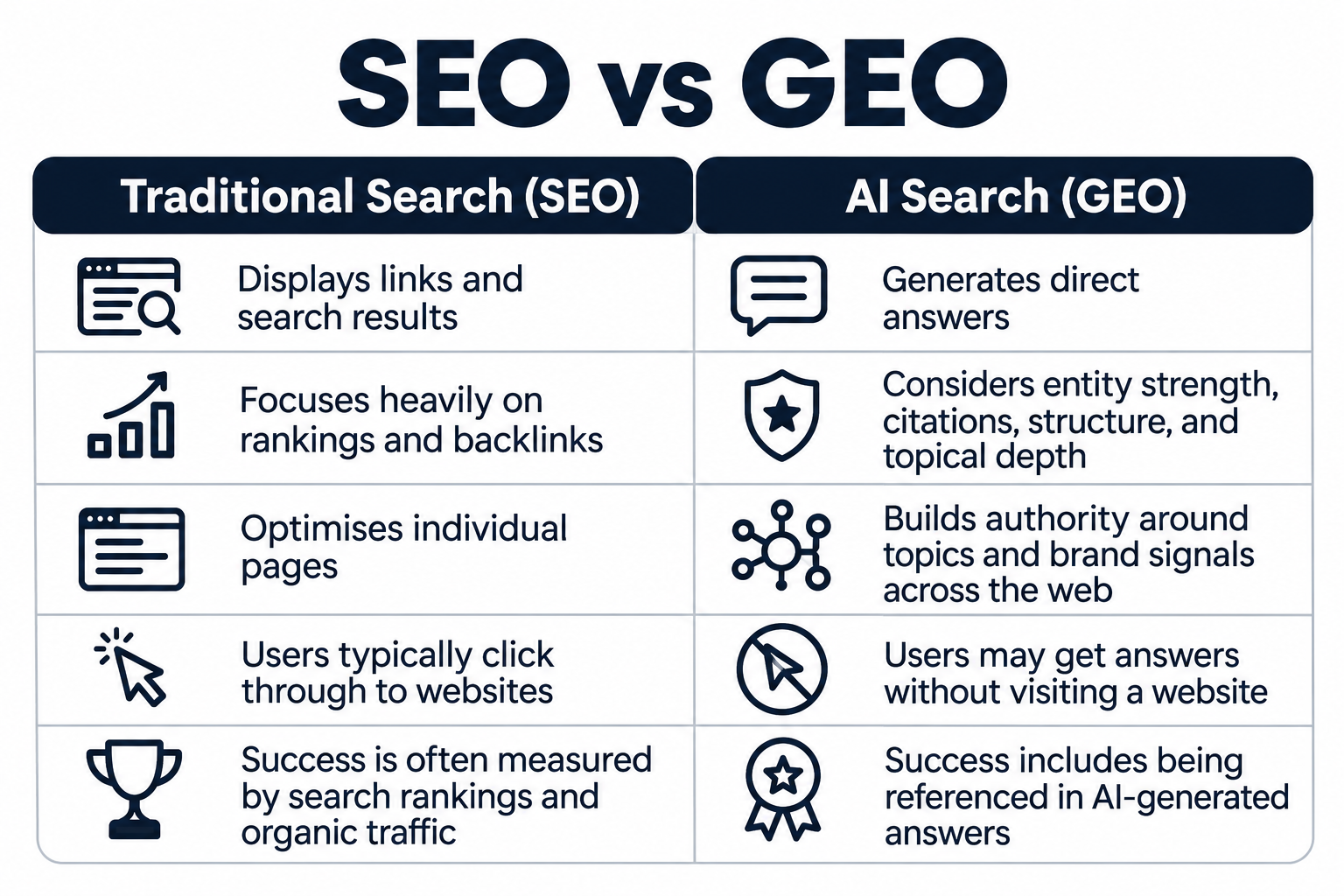
The image compares how traditional search engines rank and display web pages, while AI search platforms generate answers using relevant content, sources and brand information.
A practical example:
Asana ranked number one in traditional search results in Italy for "project initiation" but did not appear in Italian AI Overviews for the same query. Local blogs with stronger regional signals received the citations instead.
The example comes from Bright Afam's multilingual SEO visibility study. It demonstrates that a strong traditional search position does not automatically translate into AI search recognition.
Why ranking on Google does not automatically mean AI visibility
There are three main reasons for the gap between traditional SEO performance and visibility in AI-generated answers.
1. AI Platforms Use Signals Beyond Search Rankings
When ChatGPT, Perplexity, or Google AI Overviews generate an answer, they draw on several signals to identify relevant and credible sources.
These include:
Entity strength: How well-known and consistently represented your brand is across the web, including third-party articles, reviews, directories, and online references.
Citation frequency: How often your brand appears in industry roundups, expert articles, comparison lists, and relevant discussions.
Structured content: How clearly your website communicates information through headings, definitions, concise explanations, and organised content.
Topical depth: How comprehensively your brand covers a subject rather than publishing scattered articles with little connection to one another.
A 2025 Ahrefs study found that branded web mentions had the strongest correlation with Google AI Overview citations, with a Spearman correlation of 0.664. Brands in the top quartile for mentions received up to 10 times more AI Overview citations than those in the next quartile.
This means a page can rank highly on Google but still receive little attention from AI-powered search if the brand has limited external references or its content is difficult to interpret.
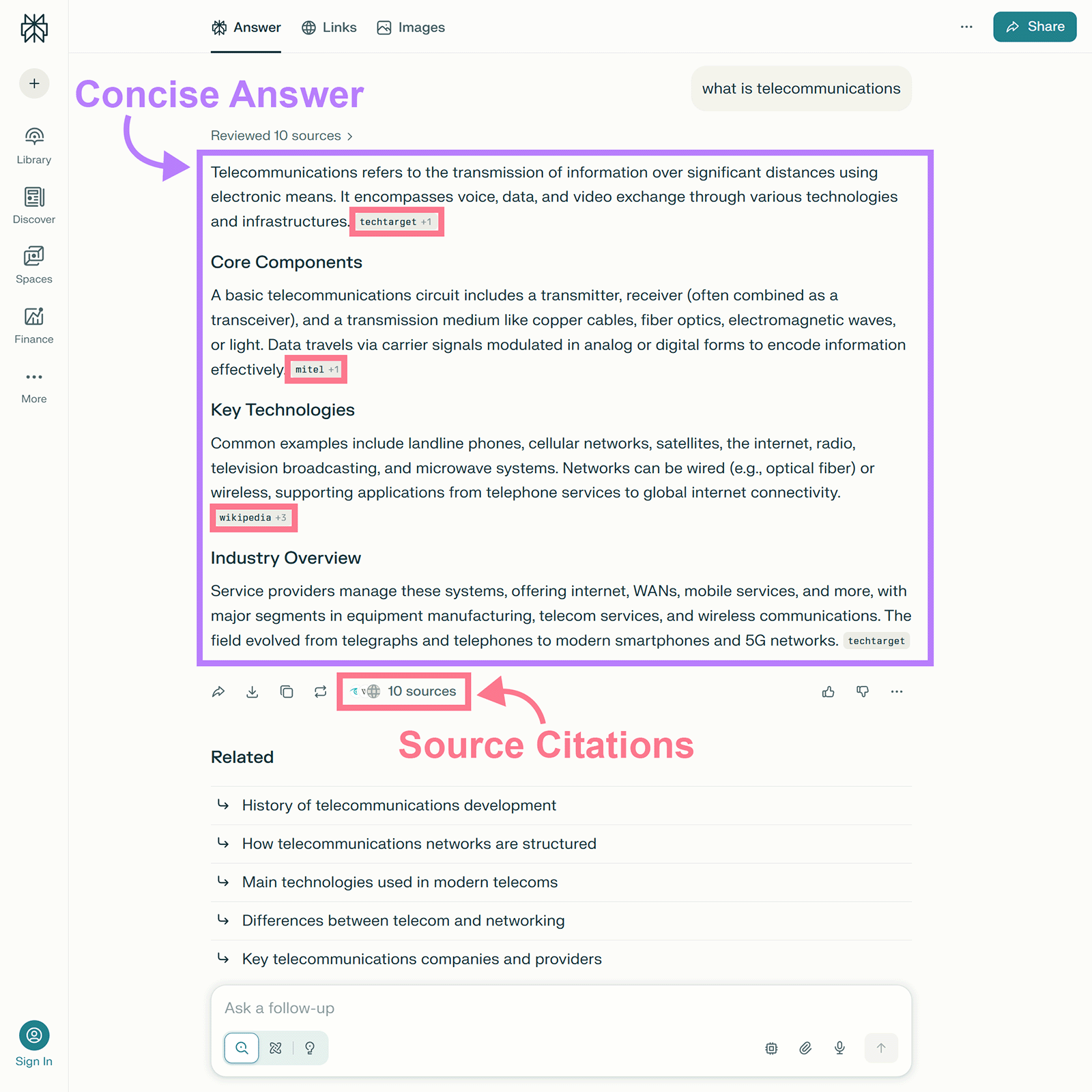
Perplexity citation, image source: Semrush
2. Brand positioning influences AI search recognition
AI platforms pay attention to how businesses describe themselves and how other sources describe them. A brand with a consistent focus on a particular subject is easier to associate with relevant queries than one whose content covers several unrelated areas without a clear connection.
A multilingual SEO visibility study published by Bright Afam for Smarketers Hub illustrates this.
He analysed 180 keywords across three sectors: project management, email marketing, and web hosting, covering the UK, French, and Italian markets.
One of the study's clearest findings was that GetResponse received ChatGPT citations in France for "newsletter software" but received zero citations for "email marketing software."
The brand and its domain authority remained the same, but its visibility differed depending on how its positioning was represented in the French content ecosystem.
The study also found that Asana achieved 100% brand visibility in AI platforms for "work management software" but recorded 0% for "goal tracking." Although the topics were related, Asana had developed considerably more content depth around work management.
These findings suggest that domain authority alone does not determine AI search performance. The relevance, consistency, and depth of a brand's content also matter.
3. Technical foundations still matter
AI search optimisation cannot compensate for a poorly structured website.
Thin or duplicate content, weak internal linking, crawlability problems, and inadequate structured data can make it difficult for search engines and AI-powered platforms to understand your website.
Bright Afam's study also highlighted the importance of technical infrastructure.
Asana's comprehensive XML sitemap, with hreflang mapping, supported stronger performance across the three markets. GetResponse's homepage-only HTML hreflang tags, without granular page-to-page mapping, aligned with significantly weaker French visibility, with an average position of 69.2 compared with Asana's more competitive positions.
The lesson is straightforward: technical SEO remains an important foundation for GEO. Your website needs to be accessible, organised, and easy to interpret before more advanced optimisation efforts can deliver their full value.
What marketers can do to increase AI seach visibility
The following five strategies address the main factors that influence whether a brand appears in AI-generated answers: topical authority, clear positioning, structured content, external recognition, and measurable performance.
Each strategy can work independently, but their impact becomes stronger when they are implemented together.
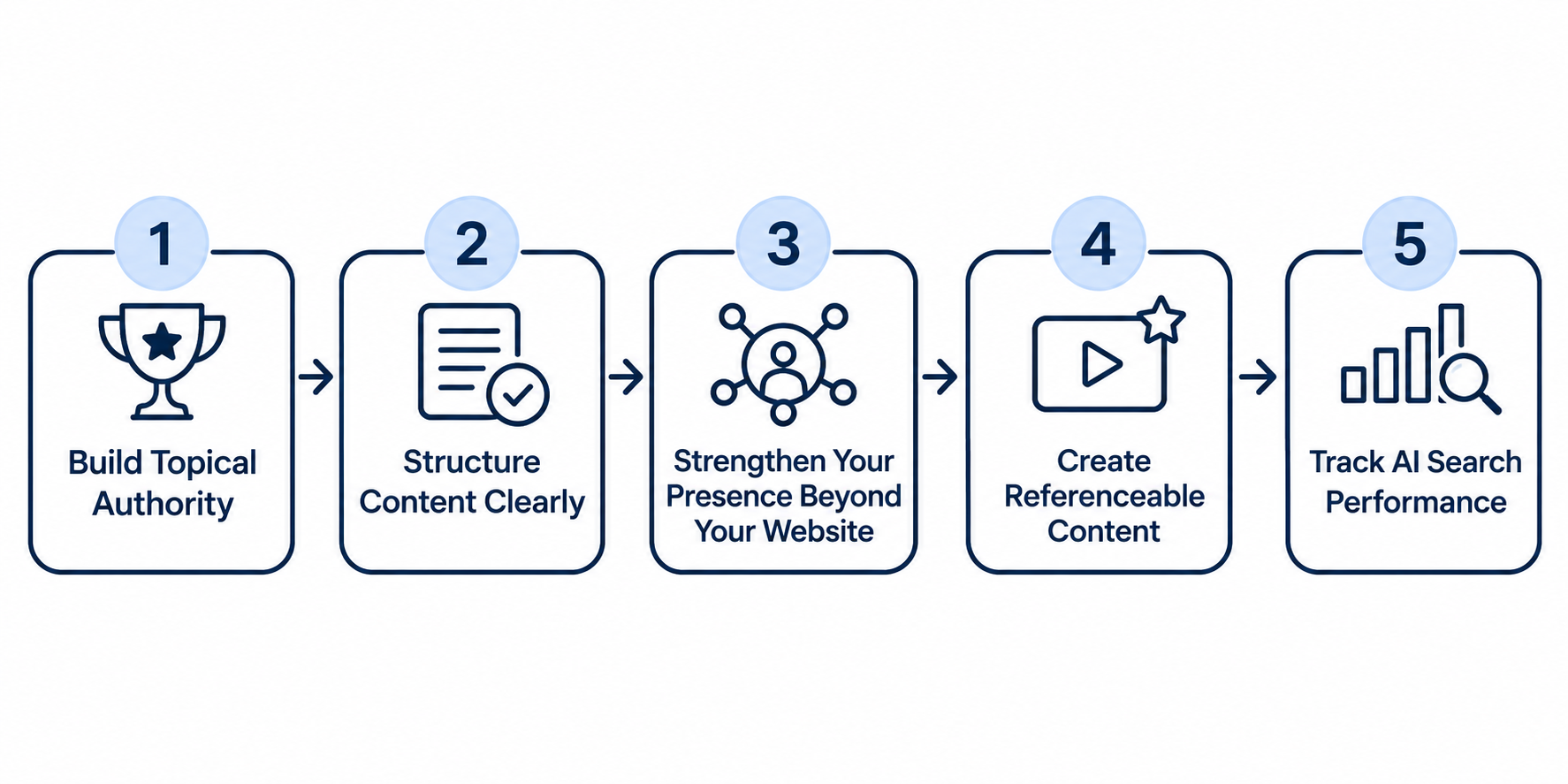
Five step AI search strategy
1. Build topical authority instead of chasing random keywords
AI platforms need context to understand what a brand knows and which subjects it is qualified to discuss.
When your business consistently publishes useful, relevant content around a specific subject, it becomes easier for search platforms to associate your brand with that topic.
Rather than publishing articles around every trending keyword, concentrate on building depth in the areas most relevant to your business.
How to do it
Choose one or two core topics and develop them consistently.
Start with a specific subject your brand wants to be recognised for.
Instead of targeting something broad like "marketing tools," narrow your focus to areas such as:
Email marketing for SMEs
AI tools for content marketers
CRM solutions for African startups
Build comprehensive coverage around these subjects before expanding into unrelated areas.
Create pillar content, not just individual blog posts.
Pillar content provides an in-depth resource on a subject and connects readers to related articles that explore specific aspects of it.
Useful formats include:
Comprehensive guides of 2,500–4,000 words, a range suggested by 2026 content research from Digital Applied.
Glossaries and definition pages.
Industry reports and original research.
Frameworks, templates, and practical checklists.
Keep these resources updated. AI-powered search platforms, particularly Google AI Overviews, may place greater emphasis on freshness for research and decision-stage queries.
Review your most important pillar pages at least every six months. Update statistics, replace outdated examples, and revise recommendations that are no longer relevant.
Build content clusters around your core topic.
Supporting articles should explore specific questions and subtopics connected to your pillar content.
For example, if your core subject is email marketing for SMEs, supporting articles could cover:
How to warm up an email-sending domain.
SPF and DKIM setup for email deliverability.
Cold email templates for Nigerian startups.
How to measure email marketing ROI.
Connect these articles through internal links so readers and search platforms can understand how the information relates.
Instead of encountering isolated posts, they can identify a connected body of knowledge around a particular subject.
Example: HubSpot
HubSpot provides a useful example of how topical authority can support AI search performance.
Despite having a narrower product portfolio than competitors such as Salesforce and Adobe, HubSpot ranks third in the business and professional services vertical of Semrush's AI Visibility Index, with a 15.4% share of voice.
Its content architecture is a significant part of the strategy.
HubSpot organises its blog into four distinct properties covering its core areas: CRM, marketing, sales, and service. Each property contains pillar pages connected to supporting articles that cover relevant subtopics.
The company has also removed irrelevant, low-performing, and off-topic content that could dilute its topical focus. Its writers reportedly spend 50–80% of their time refreshing historically strong content rather than producing entirely new articles.
The result is a more organised body of information that AI platforms can reference across HubSpot's core subject areas.
The lesson is that publishing more content does not automatically build authority. Consistent coverage, useful connections between articles, and regular updates are more valuable than publishing on every available topic.
2. Structure content clearly for humans and machines
Even useful, well-researched content can be overlooked if its information is difficult to find or interpret.
AI-powered platforms need to identify the main points in a piece of content and extract relevant information when generating answers.
If your articles bury important explanations in long paragraphs, use vague headings, or lack a clear structure, they become harder to interpret.
How to do it
Answer the question first, then explain.
Start each section with a direct answer to the question raised by its heading. Follow with the supporting explanation, examples, and additional context.
For example, a section titled "What is GEO?" should begin with a concise definition before discussing its applications and benefits.
This makes the information easier for readers to understand and easier for search platforms to extract.
Use clear heading hierarchies.
Your headings should reflect the questions your audience is likely to ask.
Examples include:
What is GEO?
How does topical authority affect AI search visibility?
Which tools can marketers use to track AI mentions?
Avoid vague headings such as "Overview" or "Key Points" when a more descriptive heading would communicate the subject clearly.
Use scannable content formats.
Organise information using:
Bullet points.
Numbered lists.
Short paragraphs of two to three sentences.
Comparison tables.
Step-by-step explanations.
These formats help readers navigate your content and make important information easier to identify.
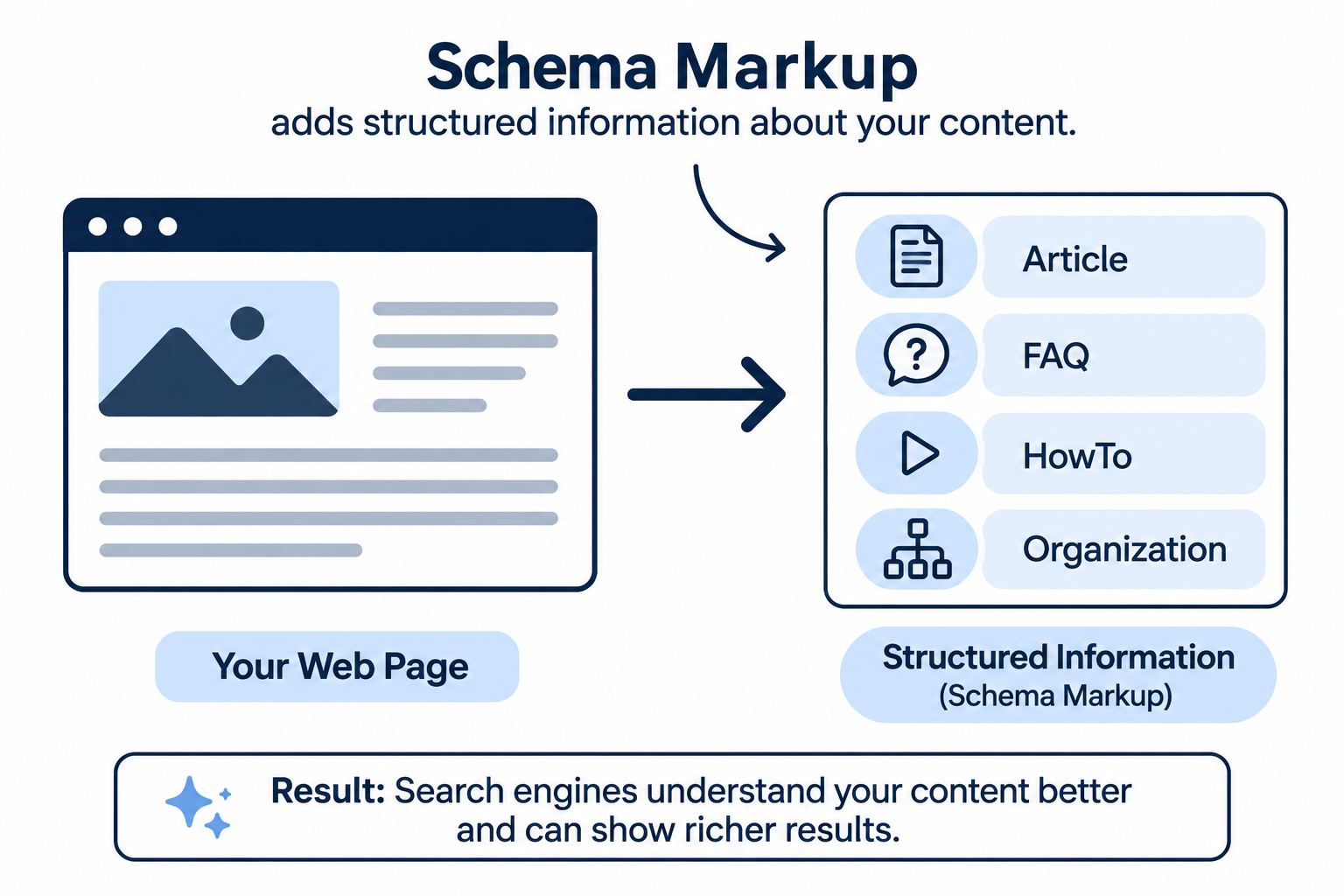
Implement relevant schema markup.
Schema markup is structured data added to your website to help search engines understand the information on your pages.
Some useful types include:
FAQ schema: For pages containing frequently asked questions and answers.
HowTo schema: For content explaining a process through clear steps.
Article schema: For editorial content, including its author, headline, and publication date.
Organization schema: For your homepage and other relevant brand information, helping establish your organisation's identity.
You do not need to implement every schema type at once. Start with the markup most relevant to your existing content, such as Article schema for important editorial pages and appropriate FAQ schema where eligible.
Schema markup supports content interpretation, but it does not guarantee that a page will be cited or displayed in an AI-generated answer.
A practical example is a page titled "Best Email Marketing Tools in 2026." A well-organised comparison table showing each tool's pricing, features, and advantages and disadvantages gives readers a clear basis for comparison and makes the information easier to extract than a lengthy review without a direct comparison.
3. Strengthen your presence beyond your own website
Your website is only one part of your brand's digital presence.
AI-powered search platforms encounter information from a wider range of sources, including industry publications, guest articles, podcasts, community platforms, directories, reviews, and online discussions.
If your brand exists only on its own website, there is less external information available to establish how others recognise and describe your business.
How to do it
Publish guest articles and expert content.
Contribute useful articles to relevant industry blogs, SaaS publications, marketing websites, and newsletters.
Focus on subjects where your business has practical experience. Each credible external reference gives readers and search platforms another source of information about your expertise.
Appear on podcasts and webinars.
Participate in industry discussions, interviews, and webinars where your brand or founder can share relevant insights.
Where transcripts are available and indexed, these discussions can provide additional opportunities for your expertise to be discovered.
Participate in online communities and forums.
Contribute useful answers and insights to relevant LinkedIn groups, Slack communities, Reddit discussions, and X conversations.
Focus on helping people solve specific problems. Consistent, relevant participation is more valuable than repeatedly promoting your business without adding useful information.
Get included in industry roundups and comparison lists.
Look for opportunities to appear in:
Best tools and software roundups.
Top 10 lists within your industry.
Product comparison articles.
Expert features and relevant industry publications.
Bright Afam's study provides a practical example.
GetResponse appeared in AI-generated responses in Italy as an alternative to ActiveCampaign, partly because a TechRepublic article mentioned it as a competitor.
The brand's own content had not established that particular association. The third-party reference provided another source of information through which AI platforms could identify it.
For African marketers building from scratch
Limited domain authority and an established off-site presence can make competing with globally recognised brands difficult. However, that does not mean African businesses cannot build a presence in AI search.
Bright Afam's multilingual study offers a useful starting point. Hostinger performed better in France than in the UK despite having weaker overall domain authority. Lower competition in the French market gave its localised content more room to gain recognition.
The implication for African marketers is worth considering. Rather than competing immediately with globally established brands across broad English-language search terms, businesses can start with specific, underserved subjects or markets.
This could mean focusing on a local industry niche, a francophone market, or a relevant community platform where established competitors have limited presence.
Three practical starting points are:
Create profiles on review platforms. SE Ranking's November 2025 data found that domains with profiles on platforms such as Trustpilot, G2, and Capterra are three times more likely to be selected as ChatGPT sources. Creating a profile is a relatively accessible way to establish an external reference for your business.
Participate consistently in one relevant community. Reddit reportedly accounts for 46.5% of Perplexity's citations. Contributing useful answers to relevant discussions can help establish your brand's association with specific problems and solutions.
Secure a guest contribution in a publication AI platforms already reference. You do not need dozens of external articles to get started. A relevant contribution in a credible publication can give your brand an additional point of recognition.
You do not need to build authority everywhere before beginning. Start with a clear subject, an audience you understand, and credible platforms where your business can contribute useful information.
4. Create content people want to reference and AI can cite
Not all content has the same value when it comes to earning references.
Generic articles that repeat commonly available information offer little reason for another website or publication to cite them.
Original research, useful frameworks, industry analysis, and data-backed insights provide something more substantial. They give other writers, marketers, and businesses information they can reference when discussing a subject.
Content formats that are naturally referenceable include:
Original research: For example, "The 2026 State of Content Marketing in Nigeria."
Industry reports: Reports containing aggregated data, benchmarks, and case studies.
Expert interviews: Q&A articles featuring named professionals and clearly attributed insights.
Case studies: Documented projects with specific objectives, activities, and measurable results.
Data-backed articles: Analysis supported by statistics and identifiable sources.
Comparison articles: Content showing clear differences between products, services, or approaches.
Practical frameworks and templates: Resources other professionals can apply and reference.
How to make your content more citable
Start each section with a direct and concise explanation.
Include specific numbers and identify the sources behind your claims.
Use comparison tables, charts, and organised datasets where they add value.
Provide actionable resources such as checklists, frameworks, and step-by-step guides.
Attribute expert contributions and original findings clearly.
Example:
Imagine a marketing agency publishes a report titled "The State of AI-Optimised SEO in 2026," based on responses from more than 100 marketers.
The report includes information about the tools marketers use, the challenges they encounter, their investment priorities, and the results of their optimisation efforts.
Other marketers and publications can reference the findings when discussing the state of AI search optimisation.
As the report earns external references, it creates additional opportunities for the agency's research and brand to appear in relevant discussions and AI-generated answers.
The value lies in producing information that adds something to the existing conversation, rather than simply repeating what is already available.
5. Track AI search performance separately from traditional rankings
You cannot improve what you do not measure.
AI search performance and traditional SEO rankings are different outcomes. A brand can improve its Google ranking while remaining absent from AI-generated answers. It can also earn consistent AI citations without experiencing an immediate increase in traditional organic traffic.
This distinction matters because marketers may invest in GEO, notice an increase in AI references, and become concerned when website traffic does not grow at the same rate.
Organic click-through rates have dropped by 61% on queries where AI Overviews appear. As more users get answers directly from search interfaces, being referenced and generating website visits are increasingly separate outcomes.
The goal is to understand both.
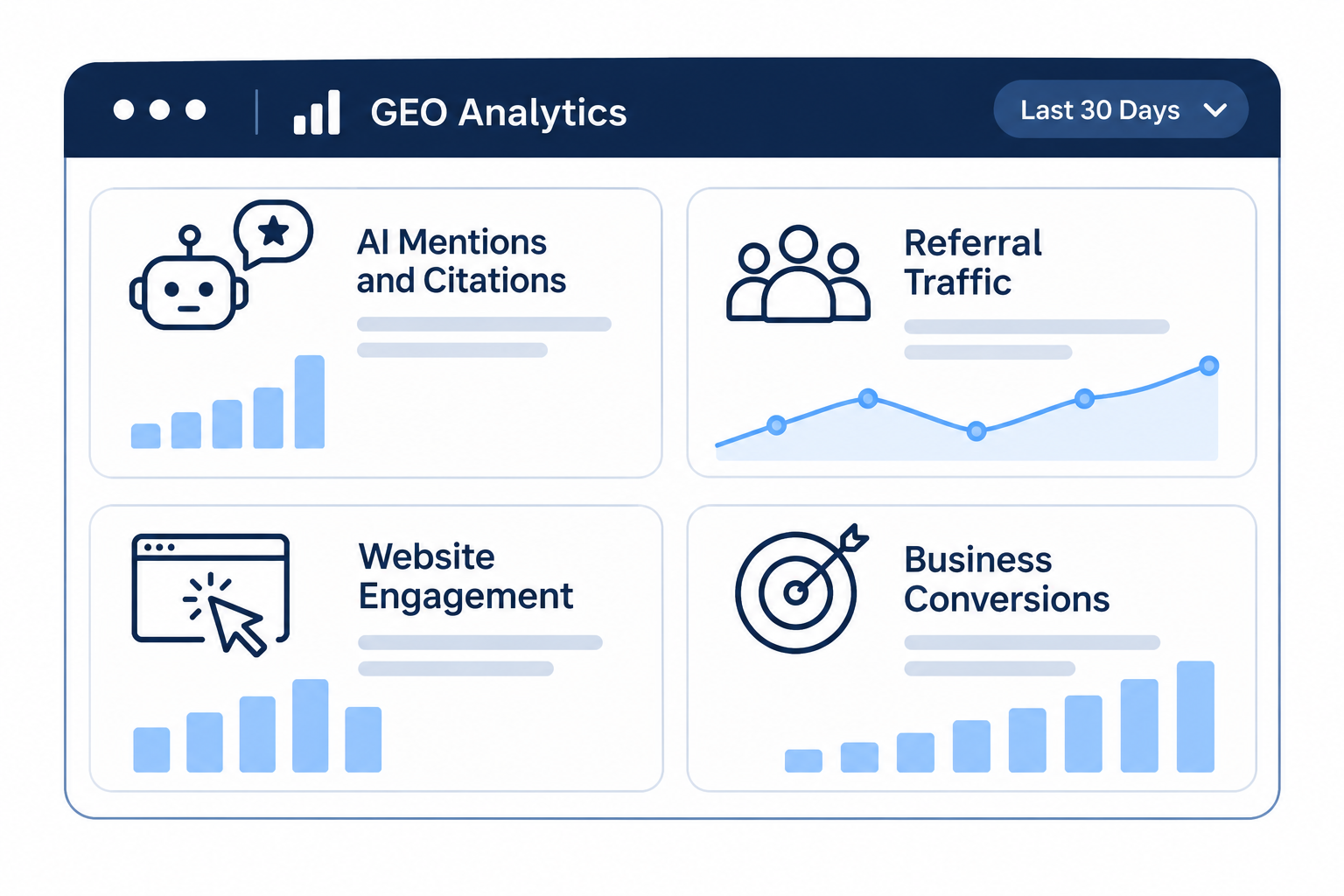
How to measure your performance
1. Monitor AI mentions manually.
Before investing in monitoring tools, establish a baseline.
Select 15–20 prompts that reflect how your target customers search for information. Focus on the questions they might ask ChatGPT or Perplexity when researching a problem or comparing solutions, rather than relying exclusively on your keyword list.
Run these prompts across ChatGPT, Perplexity, and Google AI Overviews.
Record three things:
Whether your brand appears.
The context in which it is mentioned or cited.
Which competitors appear instead.
Repeat the exercise monthly to identify changes in your brand's presence and the sources being referenced.
2. Track branded search growth.
Monitor searches that include your brand name alongside relevant product or service terms.
For example:
"[Brand] email marketing tool"
"[Brand] CRM for startups"
An increase in branded searches can indicate growing awareness and interest. It is worth tracking alongside other performance indicators, although it does not establish that AI recommendations caused the increase.
3. Monitor referral traffic from AI platforms.
When users click through from AI-generated answers, some of these visits can be identified through referral data in your website analytics.
Monitor traffic from platforms such as ChatGPT and Perplexity, and use UTM parameters where possible to improve campaign attribution.
Pay attention to the quality of these visits, including engagement, enquiries, and conversions.
One reported comparison puts average time on site for visitors referred by AI platforms at nine minutes, compared with 8.1 minutes for Google referrals.
This suggests that AI-referred visitors may arrive with stronger research intent, although engagement time alone does not establish conversion performance.
4. Measure citation frequency across third-party content.
Maintain a record of industry roundups, expert articles, product comparisons, podcast appearances, and other credible sources that reference your brand.
Look at how frequently your business appears and whether those references associate it with the subjects you want to be recognised for.
This provides an additional way to monitor your brand's growing presence beyond its own website.
5. Connect AI visibility to business outcomes.
Being mentioned in an AI-generated answer is useful, but marketers also need to understand whether that exposure contributes to business performance.
Track the actions users take after arriving from AI platforms.
Depending on your business model, these could include:
Product purchases.
Demo requests.
Newsletter subscriptions.
Contact form submissions.
Free trial registrations.
Qualified leads.
Compare conversion rates, lead quality, and revenue from AI-referred sessions with other acquisition channels where sufficient data is available.
Also consider the limitations of attribution. A customer may discover your brand through ChatGPT, return later through Google, and eventually convert through a direct visit. That journey may not be fully captured by referral analytics.
One relevant finding comes from Seer Interactive's 2026 update, which analysed 53 brands and 5.47 million tracked queries. It found that brands cited in AI Overviews earned approximately 120% more organic clicks per impression than uncited brands on the same query.
This is a useful indication of the potential value of being cited. However, it measures organic click performance, not revenue or conversion rates.
The broader point is that AI search performance should be evaluated through a combination of brand recognition, citations, website engagement, and measurable business outcomes.
Tools to monitor AI search performance
Several tools can help marketers monitor different aspects of their GEO efforts.
Tool What it does
Semrush Brand monitoring, keyword research, and AI visibility tracking
Ahrefs Backlink analysis and brand mention monitoring
Advanced Web Ranking Search ranking tracking and AI search feature monitoring
SparkToro Audience research and understanding where audiences engage with content
SE Ranking / Omnia AI search visibility monitoring and reporting
Ubersuggest (Neil Patel) AI search visibility features and SEO monitoring
You do not need to subscribe to every tool immediately. Start with manual monitoring and the analytics tools you already use. Introduce specialised platforms as your measurement needs become more demanding.
Questions to ask before implementing your GEO strategy
Before investing heavily in GEO, assess whether your current marketing and technical foundations support your goals.
Use these five questions to identify the areas that need attention:
1. Is our brand clearly associated with one or two core topics?
Can people identify what your business is known for, or does your content cover several unrelated subjects without a clear focus?
2. Does our content demonstrate actual expertise?
Do your articles include original insights, named authors, real examples, and documented experience, or do they simply repeat information available elsewhere?
3. Are we creating information worth referencing?
Are you publishing original research, useful frameworks, case studies, and data-backed analysis that give other sources a reason to reference your work?
4. Does our brand have a presence beyond our website?
Are you represented in relevant publications, industry roundups, review platforms, and online communities? Can external sources clearly explain what your business offers?
5. Can search platforms access and understand our website?
Is your website technically sound, with clear navigation, useful internal links, appropriate structured data, and properly configured international pages where relevant?
Your answers will help identify whether you should prioritise content development, external recognition, or technical improvements before investing in more advanced GEO activities.
GEO starts with strong marketing foundations
As AI-powered search becomes a standard part of how people discover information, more marketers are looking for ways to get their brands into ChatGPT responses, Perplexity results, and Google AI Overviews.
But appearing in these answers requires more than adding a few technical adjustments to your website.
Brands that consistently earn recognition are building clear topical associations, publishing credible and useful content, maintaining strong technical foundations, and establishing a presence across relevant sources on the web.
GEO does not replace traditional SEO or good marketing practices. It builds on them and makes the quality of those foundations increasingly important.
The brands that perform well in AI search will not necessarily be the ones publishing the most content. They will be the ones whose expertise is clear, whose information is useful, and whose credibility is reinforced across the web.
Start here:
Choose one or two core topics and build comprehensive coverage around them.
Structure your content so readers and search platforms can easily identify the main information.
Establish your presence beyond your website through relevant publications, review platforms, and online communities.
Create original research, frameworks, and case studies that others can reference.
Track AI search performance separately from traditional rankings, and connect it to meaningful business outcomes.
When someone asks ChatGPT, "What are the best tools for email marketing?", the brands most likely to appear are those that AI platforms can discover, understand, and confidently reference.
That is what GEO aims to build, and it starts with the quality of your existing marketing foundations.