
Getting people to trust you with money is hard. It’s even harder if you’re into fintech marketing because you’re competing with traditional banks—some of which have existed for centuries.
However, brands like Monzo, Chime, and Piggvest seem to have cracked the code. They’ve recorded remarkable successes that many initially thought impossible.
To put these successes into perspective, Monzo reported having 6.9 million active weekly users in 2025. Chime’s 2025 second-quarter report shows 8.7 million active members. Piggvest boasts over 5 million customers who save and invest through the platform.
In this piece, we’ll take a deep dive into three fintech marketing strategies: Monzo’s radical transparency, Chime’s consumer education, and Piggyvest’s niche brand storytelling.
If you’re a fintech marketer chasing more than clicks, stick around because this is for you. You’ll learn:
Lessons fintech marketers can learn from Monzo’s radical transparency
Monzo, formerly Mondo, was founded in 2015 in the United Kingdom (UK). It was originally a fintech startup before being granted a banking license and now operates as a digital bank.
Lesson 1: Focus on community
From day one, Monzo has always been a community-focused brand. It’s the main driving factor behind their next-level transparency.
Users are always included in conversations around product features. Their community forum isn’t just a feedback tool; it’s a source of ideas.

Monzo’s customer suggesting the Pots feature in the community forum
Source: Monzo
For example, Pots, a popular feature that allows users to save money and earn interest, was adopted after a community member proposed the idea.
On a similar note, Monzo Labs, a beta program, gives users early access to new features and records feedback. This ensures that the product evolves with actual user input and addresses intended pain points.
This design-by-community approach fosters a transparent environment where trust thrives. Users actually feel like a part of the process and not an afterthought.
Lesson 2: Own your mistakes
When things go wrong, Monzo doesn’t hide like most fintech companies do, leaving users in the dark. The company maintains a status page that shows incident history. Users can even subscribe for incident updates.

Monzo’s incident status page
Source: Monzo
According to Chris Evans, former Technical Director of Platform and Reliability at Monzo, “Transparency is a core value of the company. You had to make a case for making things private and that extended to incidents.”
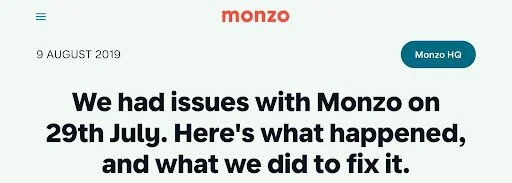
A technical postmortem blog post published by Monzo
Source: Monzo
In addition to maintaining an incident page, Monzo also published technical postmortems. This blog-style content clearly communicated what went wrong in layman's terms, what the company did to fix it, and measures put in place to avoid a repeat.
This degree of transparency was a breath of fresh air when Monzo launched, and definitely a game-changer in a space where brands went quiet during outages while users ranted on social media.
About Monzo using transparency to earn customer loyalty, Chris said, “It’s important to be open when things are not working as much as when they are. Monzo had a very strong customer base in the early days who basically loved it for that.”
Fintech marketers, especially those working with startups, need to be honest with their community when things go south. It’s non-negotiable if you want to stand out.
Takeaways
Actively interact with users on forums and other communication channels. It’s a great way to build relationships and gain useful insights.
Use beta programs to gather real-time feedback when developing a new product feature to ensure alignment with users’ needs.
If you experience a downtime or technical issue, don’t go radio silent. Users need to know what happened and what you’re doing to fix it.
Fintech marketing nuggets from Chime’s education and influencer strategy
Founded in 2012, Chime is a financial technology company that targets low to middle income Americans. It partners with The Bancorp Bank and Stride Bank to offer banking products.
Lesson 1: Quality information creates trust
Financial education is at the heart of Chime’s brand strategy.
Kira Traore, Head of Corporate Social Impact at Chime, puts it this way, “We know many people didn’t grow up learning about personal finance. We want to be a true partner on your financial journey. It’s never too late to learn about managing your money. We’re here to help.”

Kira speaking on comprehensive financial education in Episode 2 of Impact Deconstructed
Source: Social Impact World YouTube
Chime’s blog, In The Green, plays a key role in its financial education strategy. It covers a wide range of banking topics, written by experts with beginner-friendly language that makes the reader feel like it’s a friend explaining banking concepts.
Chime’s online resources have grown to the point where the brand is often the first point of contact for people searching for information online. According to Kira, every month Chime’s content brings about 600,000 people to their website organically.

Kira highlighting Chime’s content efforts and results in Episode 2 of Impact Deconstructed
Source: Social Impact World YouTube
These people come for the information, and many end up becoming customers. Proof that quality information is a lead magnet that never fails.
Lesson 2: Influencer marketing still works
Many fintech marketers underrate the impact of influencer marketing when done right. Great influencers already have a solid reputation and a loyal community you can tap into.
Chime understands this and has repeatedly leveraged influencers and finance experts to promote products like MyPay, and demystify money management, strategically positioning their brand as the logical solution.

Kai Cenat and Fanum promoting Chime’s MyPay feature
Source: Chime
They’ve partnered with celebrities like Kai Cenat, Fanum, Zach King, T-Pain, Big Sean, Deion Sanders, and Keith Lee. They’ve also collaborated with popular financial educator Tiffany Aliche, also known as The Budgetnista.
The key to a successful influencer marketing campaign is finding someone who has shared values. Then you have to make sure that they’re promoting a product that’s a fit for their audience.
Takeaways:
Use high-quality content that answers your audience’s questions to build trust and affinity for your brand.
Identify influencers with a strong niche audience that align with your brand’s values and partner with them to create authentic campaigns.
The influencer and product must match. For example, a finance expert with an audience of high-income professionals would be a mismatch for Chime’s MyPay feature, as this audience is unlikely to be living paycheck to paycheck.
How Piggyvest uses storytelling to win in fintech marketing
Piggyvest, originally Piggybank, was launched in 2016 as a digital savings platform. In 2019 it was rebranded to Piggyvest and started offering investment opportunities and financial products.
Lesson 1: Tell relatable stories
Piggvest’s growth is fueled by a deep understanding of the Nigerian market. They're able to tell relatable stories, leveraging local voice, memes, and pain points.
Tobe Okoh, content writer at Piggyvest, sheds light on this, “From the jump, storytelling was integral to Piggvest’s strategy. We’ve leaned into formats that are human and helpful. The goal for each piece of content is to educate and connect, and it has been powerful to see our content spark emotional connections and drive real results.”

Grown Ups comic series banner
Source: Piggyvest
According to Tobe, Grown Ups, a comic series that tells money stories from a Nigerian perspective has led to over 40,000 app downloads. MyPiggyvest, a series that spotlights the stories of real Piggyvest users, also plays a key role in driving conversions.
In Nigeria, women are often excluded from conversations about money. Which is why Tobe launched the Women and Money series, with the goal of including women in money conversations. The response has been largely positive and has helped get a lot of women behind the brand.
Telling stories with rich cultural undertones isn’t just a nice-to-have, it’s a strategic asset. People should be able to connect with your stories on a personal level. It makes them feel seen, and in many cases they end up becoming customers.
Lesson 2: Track content performance
You’ll never know what to double down on if you don’t track content performance. Tobe believes conversion is what you should be looking at when analyzing performance; whether it’s app downloads or product page signups.
Beyond numbers, measuring brand sentiment is another great way to gauge your content marketing efforts. Tobe shares a few ways they do so at Piggyvest, “We analyze user responses through surveys, emails, and social listening. Especially after publishing educational or story-driven content or launching other content initiatives.”

Piggyvest’s CMO Josh Chibueze at the 2024 Open House event
Source: Piggvest
Insights from in-person events like Piggvest’s Open House equally help identify when an initiative hits the mark. It’s a great opportunity to find out what the audience is curious about and wants to see more of.
You need to allow a reasonable amount of time before drawing a conclusion from content performance metrics. This can be anywhere from a few weeks to a few months, depending on the type of content and platform.
For example, on platforms with fast-moving algorithms and generally short content lifespans like TikTok, you can get a solid sense of performance in a week or two. YouTube content, on the other hand, generally has a longer average lifespan of about a month.
As Tobe rightly points out, “While content is a powerful marketing tool, it’s often a long game. Not every story converts right away, and that’s okay, too.”
Takeaways:
Use relatable stories to build emotional bridges and trust. In Nigeria, for instance, a story about college debt isn’t something people can relate to because student loan systems are still new and inefficient.
Organizing in-person events is a great way to connect with your community and gather valuable insights that no survey form or sophisticated software can offer.
Remember that it may take some time to see results from content efforts, and that’s okay. The most important thing is to study the algorithm of each platform, find out what works and double down.
What Monzo, Chime, and Piggyvest have in common
Now that we’ve explored individualities, what could three fintech brands across different continents—Europe, North America and Africa—have in common?
1. Trust is earned, not marketed
You can’t market trust with ads or flashy campaigns. Your actions and inactions determine whether people will trust you, especially in a competitive industry like fintech.
You have to show consumers that they matter if you want to gain their trust. It could be keeping them in the loop, creating quality information resources, or stories that make them feel seen and understood.
2. Content must serve, not just sell
Content that only pushes products is quickly forgotten. Consumers only care about their problems. So, you need to provide upfront value that speaks to their concerns before trying to sell to them.
In fintech marketing, content that drives results is that which solves real problems. It could be a simple explainer guide or a story that helps your audience see how others handled similar challenges.
3. Authenticity beats perfection
Perfection is an illusion, and you shouldn’t waste time chasing it. Too much polished, perfect messaging can sometimes make you appear out of touch.
Your users don’t expect perfection. They want authenticity and transparency. It shows in how you tell stories, respond to feedback, and handle difficult situations as a brand.
💡 Also read — 2026 marketing trends: 6 expert marketers share what to expect
Conclusion: The best of three worlds
Successful fintech brands walk the talk. As a fintech marketer, honesty, accountability, and transparency are your best allies. Consumer trust is something you earn. Day by day. Post by post. Update by update.
The lessons highlighted in this article aren’t just marketing strategies; they’re acts of stewardship. They’re ways of saying: we see you, we understand you, and we’re building with you in mind.
When you combine transparency, quality content and authentic, irresistible storytelling, you get the best of three worlds. That’s how you help your brand stand out as a fintech marketer.
Loved reading these marketing lessons from winning brands?
Take your knowledge a step further by implementing some of these strategies and many more with Inside the Marketers Room. You’ll find countless insights from 50+ global marketing leaders who walk you through how top teams think, plan, and execute marketing that actually drives results.