
How to fit storytelling into SEO content without losing searchability
Balancing storytelling and SEO can sometimes feel like walking on a thin bridge. On one side, you want your content to rank and bring traffic; on the other, you want readers to stay, feel connected to the story, and take action.
I’ve been told this countless times in my early years as an SEO content writer: “Write for humans, optimize for search engines.” It sounded simple enough, but when it was time to sit down and write, that advice always felt incomplete. After all, how do you really write for humans without messing up what the algorithm needs?
Do you start with a keyword or a story?
Do you add that founder’s quote or cut it for brevity?
Do you keep the anecdote or delete it for clarity?

That balance between storytelling and SEO is where many writers often get stuck. Not because they don’t understand SEO, but because they’re unsure where the story fits in and how to use it without hurting rankings.
Over time, I’ve researched and experimented with ways to use storytelling strategically in SEO content. I’ve tested it as a tool to improve content structure, engagement, rankings, and even conversions. That process has shown me that stories in SEO content aren’t just creative extras; they’re content visibility building blocks when used the right way.
This article is for every content writer who’s been caught in that same tension. You’ll learn:
What does storytelling in SEO content actually mean?
When people hear “storytelling,” they often picture novels, long personal essays or emotional write-ups. But that’s not what SEO storytelling is.
In SEO writing, storytelling involves weaving real human elements, such as characters, emotions, struggles, and outcomes, into a structured, search-friendly format.
What counts as storytelling in SEO?
In SEO content, storytelling looks like this:
A real-life example or anecdote
Descriptive context (who’s involved, where, and when)
A relatable challenge and how it was solved
A conversational, human tone
Emotional hooks like frustration, surprise, or relief
A clear takeaway, insight, or shift in mindset
How does storytelling make SEO content more effective?
To some, SEO content is a game of keywords, headings, and backlinks. Optimization matters, but people don’t show up for a keyword; they show up for a solution. And the way you deliver that solution can be just as powerful as the solution itself. That’s where storytelling comes in.
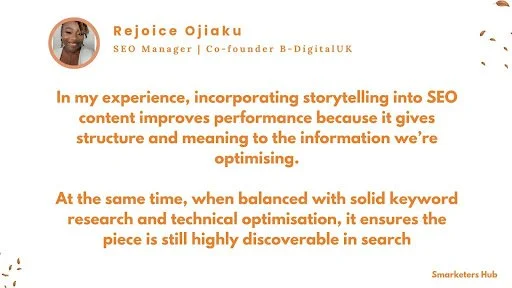
In this session, Rejoice Ojiaku, SEO Manager & Co-founder B-DigitalUK, draws from her own experience to show how blending storytelling with SEO brings her better results than stuffing keywords ever could.
1. It increases engagement, dwell time, and reduces bounce rates
Nothing beats the feeling of reading a blog and seeing your own experience mirrored in it. That’s the story pulling you in. When people feel understood, they scroll deeper, click around, and stay longer. This naturally reduces bounce rates and sends a strong signal of value to search engines.
2. It encourages shares and backlinks
People don’t share plain content; they share what moved them, what made them nod in agreement, or what finally gave them clarity. That’s why some of your story-driven pieces often become your link-worthy assets. A story makes people feel something, and that feeling pushes them to hit “share.”
3. It boosts brand recall
Data informs, but stories persuade. A study by Jennifer Aaker at Stanford found that people are 22 times more likely to remember stories than standalone data. For your brand, that means stronger recognition, repeat clicks, and readers who come back because they remember the experience your content gave them.
4. It differentiates your content
Let’s be honest: most blogs in your niche sound the same. But your lived experiences, mistakes, and wins are elements that AI and templates can’t replicate. Storytelling makes your writing unique, not like AI-written or the thousand other articles competing for the same keyword.
“I’ve found that storytelling also helps content rank better because search engines increasingly reward depth, clarity, and relevance. Rather than just inserting keywords, storytelling creates a natural flow where search terms are used in context. This not only improves readability but also signals topical authority.”
5. It aligns with user intent
The best blogs feel like they were written just for you. When someone Googles “How to fix low clicks on a marketing campaign,” they don’t just want the fix. They want to know someone else has been there, panicked the same way, and found a way out. A story that reflects their frustration or fear makes them feel seen and more willing to trust your advice.
6. It improves content structure
A good story follows a natural arc: beginning, middle, and end. When you build SEO content with that same flow, it feels less like a keyword checklist and more like a conversation. That rhythm helps readers stay with you until the final line.
7. It makes complex ideas digestible
Technical concepts can be boring and even difficult to understand.
Storytelling gives these ideas life. Instead of saying “Use canonical tags to avoid duplication,” you say, “We noticed our product pages were outranking our collection page, here's how canonical tags saved us.” Same advice, but framed in a way that’s easy to understand, apply, and remember.
When readers can visualize a real situation, they’re more likely to retain the lesson and act on it.
“From a conversion perspective, stories build trust. They connect emotionally, making readers more likely to engage with a brand or take action. In short, storytelling elevates SEO content by turning it from a keyword-driven asset into something that informs, resonates, and converts.”
For Rejoice, storytelling when balanced with solid SEO practices transforms content into something both discoverable and meaningful.
9 Storytelling elements to support SEO content
Before we dive in, here’s what Deborah Oyewole, former Content Marketer at the Freelance Coalition for Developing Countries (FCDC), shared when I asked which storytelling element has been most effective in her work.
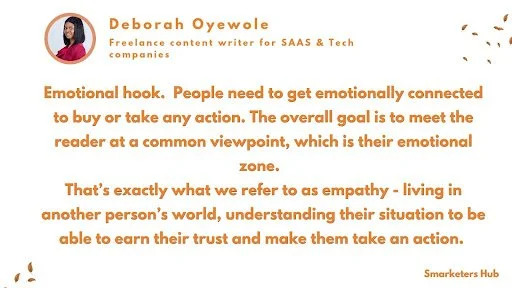
Her point is clear: without emotional connection, even the highest-ranking blog can leave readers cold.
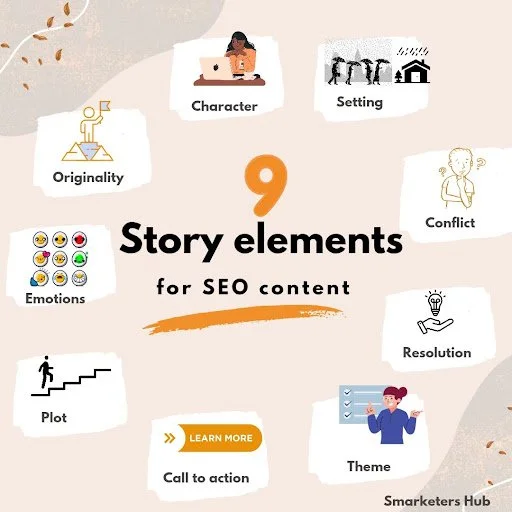
The nine storytelling elements below aren’t strict rules; they’re creative building blocks you can lean on depending on your blog’s purpose and format.
You don’t need to use every single one. But knowing how they work makes it easier to shape SEO content that connects with real people and still performs in search.
1. Character
Every story needs a human at the center. It could be your reader, a customer, a founder, or even yourself.
Characters make abstract ideas relatable because readers can see themselves in the journey. Instead of saying “Marketers struggle with low CTR,” say something like “ A digital marketer I know was frustrated watching their CTR drop week after week.” Suddenly, it’s no longer a faceless struggle; it’s a story readers can connect with.
2. Setting
Context, like time, place, or environment, helps the reader picture the scene and makes your example feel grounded. For example, “During Black Friday sales, when ad competition peaked, our team noticed…” instantly creates a setting that anchors your insight in reality. Setting gives your story a backdrop.
3. Conflict
This is the tension point that fuels curiosity. Without conflict, there’s no reason for a solution. What challenge was the character facing?
Conflict makes readers lean in because they want to know what happens next. In marketing, the conflict could be a drop in rankings, wasted ad spend, or a technical error messing with performance.
4. Resolution
This is where the tension breaks and the value comes in. How did the problem get solved? The resolution is your method, process, or insight that ties neatly to the conflict. It shows readers that the struggle was real, but the solution was possible, and here’s how they can apply it too.
5. Theme
Every strong story has a deeper message. The theme is the underlying lesson you want readers to walk away with. In marketing settings, that might be “understanding your users matters more than chasing algorithms.” The theme keeps your story meaningful, not just memorable.
6. Plot structure
Even a short anecdote should follow a natural flow: beginning, middle, and end. Dropping a quick quote without context isn’t enough. Instead, set up the situation, build the tension, and then deliver the result. This structure makes your writing easier to follow and keeps readers engaged.
7. Emotional hooks
Facts are important, but emotion makes people stay. Tap into people's frustration, curiosity, excitement, or relief, especially in your intros and transitions. A hook like “We’d spent $2,000 on ads with zero conversions, and panic was setting in…” instantly draws readers in because they feel the emotion behind the data.
8. Authenticity
Nothing kills trust faster than a made-up story. Don’t exaggerate or fake data.
Use real experiences, real people, and real outcomes. Add screenshots, timestamps, or direct quotes to back it up. Authenticity builds credibility, and credibility is what makes readers trust your advice.
9. Call to action
Every good story should lead somewhere. Once you’ve delivered the insight, guide the reader toward the next step, whether it’s trying a tactic, downloading a guide, or booking a consultation. Don’t just let them scroll away.
Deborah closed out her thoughts with a reminder that keeps all of this in perspective:
“At the end of the day, SEO is first for humans before search engines. We thought about our audience before writing, and we must write for them rather than search engines. What’s the essence of high-ranking content that humans can’t resonate with? We all know the outcome of that - high bounce rate.”
Algorithms will always evolve, but stories will always speak to humans.
💡 Also read: How my creative writing brain makes me a better SaaS content marketer
How to blend storytelling into SEO blog structures
This is where most SEO writers and content marketers get stuck. But it’s not about choosing between ranking and storytelling; it’s about placing them where they belong.

The Smarketers Hub blog on 7 hidden direct traffic tactics marketers miss does this well. It doesn’t sacrifice SEO structure for story, or story for SEO. Instead, it blends both worlds. Let’s break it down.
1. Start with a story hook in your introduction
An intro should grip the reader, not just state the topic. Start with an anecdote, customer quote, or conflict that sets the emotional tone. Also, try to place your primary keyword within the first 100 words of y/our intro, either just after or inside the story.
The article begins with a striking observation about Moz’s analysis, revealing that Google reduced organic listings on 18.3% of SERPs. Before readers even think about keywords, they’re drawn into the narrative.
And just after that hook, the blog neatly pivots into an SEO context by talking about the hidden power of direct traffic. That’s a clean blend; story sets the tone, SEO keeps it relevant.
2. Make the problem section relatable
Highlight a challenge your audience genuinely experiences. You’re not just explaining the problem; you’re making them feel it.
Right after the hook, the blog lays out the challenge: ”Many marketers overlook direct traffic and overspend on ads.” Instead of throwing jargon, it paints the frustration marketers actually feel, wasting money chasing traffic while ignoring a source of high-value visits.
That’s how the problem section pinpoints the readers’ reality while naturally embedding keywords like “ads,” “budget,” and “traffic.”
3. Use micro-stories throughout the body
Don’t just list tips; bring them to life with mini-narratives, metaphors, or customer moments. Each tactic in the blog is reinforced with small narratives and images that readers can picture.
For instance, in explaining ad-heavy strategies, they use the phrase: “Chasing traffic as water bounces off hard rocks.” That metaphor makes the pain point stick in your head far better than a dry sentence would.
These micro-stories keep readers engaged across the blog while keywords continue flowing naturally.
4. Include a full case study or narrative example
Drop in a full, real-world example that walks through a transformation from problem to result. Case studies build authority and let you integrate internal links, related keywords, and anchor text without it feeling forced.
The HoneyCart example is the article’s full narrative moment. A brand struggling with empty volume shifted to quality-focused strategies and ended up with a 900% increase in impressions and 450% more clicks.
This is a classic story arc: problem, pivot, and result. Also, it doubles as an SEO booster because it’s packed with measurable proof, topical authority, and natural link opportunities.
5. Echo the story in the conclusion
Wrap things up by referencing your opening story or restate the lesson in a way that feels earned. Naturally, use your secondary keyword in this section.
Instead of closing with a generic summary, the case study example loops back to its opening point. The conclusion reinforces that direct traffic isn’t just about numbers; it reflects loyalty, trust, and brand equity. This is storytelling closure, tying back to the intro while also working in secondary SEO phrases around “brand strength” and “trust.”
6. Keep your SEO structure clean
A clean SEO setup helps both readers and search engines understand your content. Use keywords naturally in your headings, introduction, and key sections.
Even with storytelling woven in, the blog keeps its SEO scaffolding sharp with:
Numbered subheadings
Short paragraphs
Clear keyword placement in each section.
This balance shows that clean SEO formatting doesn’t disrupt narrative flow; it makes it stronger.
7. Use visuals and user-generated stories
A story is incomplete without visuals to help readers imagine the journey. Use screenshots, quotes, or graphics that support the narrative and add credibility.
Smarketers Hub supports its claims with screenshots and data charts, not just words. For example, it shares Moz’s stat that Google has reduced organic results by 18.3%. That visually backed fact works like a mini proof point, grounding the story in data. It’s a storytelling technique that doubles as SEO-friendly credibility.
8. Keep it mobile and voice-friendly
Write like your reader talks and design like they’re on their phone (because they probably are). Think: “How would I say this out loud?” Then write like that, but edit out filler words.
The writing style of the blog is simple, punchy, and easy to skim on mobile. Short sentences, an active tone, and conversational phrasing make it feel like advice you’d hear in person.
For example, lines like “Don’t spend all your budget on ads just to acquire traffic” read like someone warning you directly. That’s why it works both for mobile readers and voice-search-friendly phrasing.
💡 Also read: 3 editors share what makes a standout B2B piece
Common mistakes to avoid when mixing storytelling with SEO content
Even strong writers can get carried away with a good story. But if it hurts your content clarity, the whole piece suffers. Storytelling in SEO isn’t always about how creative you can sound; it’s about how useful, relevant, and accessible the story feels to the reader. Here’s what to avoid:
1. Dragging the intro too long
Readers don’t have the patience for a four-paragraph life story before you make your point. A great intro should be sharp: hook with your story, then quickly pivot to the topic.
If your anecdote doesn’t connect back to the reader’s problem within the first 150 words, it’s fluff. Keep intros tight and directly relevant.
2. Drifting away from the keyword
It’s easy to get lost in your own story, but if your narrative wanders too far, so does your reader. Keywords act like a compass; they keep your story aligned with the searcher’s intent. Always circle back to your main keyword or theme, so the story enhances clarity rather than burying it.
3. Ignoring the reader’s intent
The best SEO content solves problems, not just entertains. If your story overshadows the solution, readers leave unsatisfied.
Ask yourself: Does this story help answer the reader’s question, or does it distract? A strong narrative should highlight the challenge, then make your solution shine brighter.
4. Stuffing keywords into every line
Keyword overload is the fastest way to kill the natural flow of your story. Instead of repeating the same phrase endlessly, weave in variations, synonyms, and related terms. Let the story do some of the SEO heavy lifting; context-rich narratives can also rank without keyword stuffing.
5. Writing walls of text
Big, unbroken blocks of text are overwhelming, especially for readers on mobile. Even the best story loses impact if it’s hard to scan. Use short paragraphs, subheadings, and bullet points where needed. A well-structured story feels effortless to read.
6. Using uncompressed media that slows the page
A beautiful image or video supports your story, but not if it slows the load time. A sluggish page pushes readers and Google away. Always compress media, use lightweight formats, and test speed with tools like PageSpeed Insights. A story works if it reaches your audience fast.
7. Overcomplicating your language
You’re not writing a novel; you’re writing to connect and convert.
Jargon, heavy metaphors, and overly complex sentences create communication barriers. Keep your language conversational and simple, like you’re explaining the concept to a colleague over coffee. The easier your story is to follow, the wider your reach.
8. Skipping clear structure
A story without structure is just rambling. As mentioned earlier, anecdotes need direction: beginning, middle, and end. The same applies to SEO blogs to guide your reader step by step. Use headings, transitions, and clear signals to show where the story is going. Structure gives your narrative power.
9. Writing for yourself, not your reader
Readers don’t care about you unless your story connects to them. Every narrative should reflect their struggles, language, and wins. Personal stories are fine, but only if they’re framed in a way that makes the reader see themselves in it.
Make your content about their journey, not just your creativity.
Conclusion
Storytelling and SEO are not enemies; they’re partners. One gives your content structure and visibility; the other gives it heart and meaning.
The truth is, keywords alone won’t make readers stay, and stories without strategy won’t rank. But when you merge both, you get content that not only shows up in search results but also sticks in people’s minds.
The next time you write, don’t think of storytelling as a “nice-to-have.” Think of it as the bridge between search engines and a real human connection, especially in this AI content era. Test it, refine it, and let your experiences guide the way you weave stories into your SEO process.
Want to learn more about creating content that drives performance that matters to businesses in an AI-first world? Get Inside the Marketers Room. It’s a practical handbook packed with hard-won insights from 50+ global marketers who’ve done the work and delivered results.