2026 marketing trends: 6 expert marketers share what to expect
Most marketers I know hate industry predictions.
Yet, this is the time of year when all kinds of marketing predictions begin circulating on the internet. As we reflect on the industry’s changes, we can’t help but wonder: “What’s next?”
2025 has been a year of fast-moving trends across AI, SEO, advertising, and more. From generative AI tools, AI overviews, LLMs and zero-click searches to unhinged campaigns that show audiences value authenticity and humor, there’s a lot to keep up with.
But as we approach 2026, how do you stay ahead and even focus on what matters? In this article, six marketers share their expectations for marketing in 2026, based on their experiences and patterns they've observed in the industry.
Table of contents
Trust, authenticity, & human connection
1. Brands that prioritize trust, authenticity and human connection will stand out
Aisha Owolabi
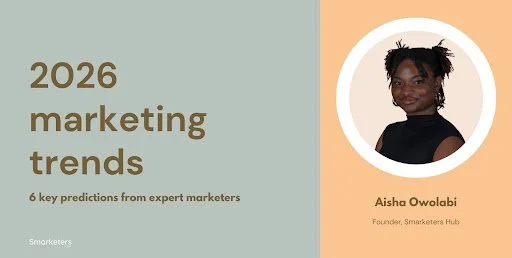
What marketing trends do you foresee in 2026?
We’ve hit peak content abundance, and there's still more to come. With generative AI lowering the barrier to entry, it’s never been easier to produce professional-looking campaigns, repurpose ideas, or copy competitors’ formats.
But that sameness is exactly what’s driving content fatigue. People are tired of scrolling through infinite carousels that look and sound the same, and are gravitating towards creators, brands, and communities that feel real, where the storytelling reflects lived experience and cultural truth.
Brands that prioritize this direction in their voice, visuals, and creator partnerships will stand out.
Generative Engine Optimisation (GEO) & visibility beyond clicks. Search visibility is no longer just about ranking for keywords; it’s about being cited, referenced, and surfaced inside new AI-driven discovery layers, from Google’s AI Overviews to LLMs like ChatGPT.
How to prepare for growth:
Stay on top of current behavioral shifts: In 2026, knowing where and how to invest in content for AI search will remain one of the hottest topics in marketing. The playbook is still being written, so the smartest thing to do is to continue experimenting and paying attention. Watch how your content performs across AI search and learn what kinds of data, structure, and storytelling get cited.
Shift your budget and time from “more” to “better”: Specifically invest in fewer, stronger content assets that lean into authenticity, community voice and co-creation (with creators, micro-influencers, users) to build a brand that feels human in an automated world.
Build AI literacy and test early: Learn how generative engines surface information, test how your brand appears across them, and stay curious about how people now discover products and ideas.
2. B2C campaigns will break out on LinkedIn
Olabinjo Adeniran
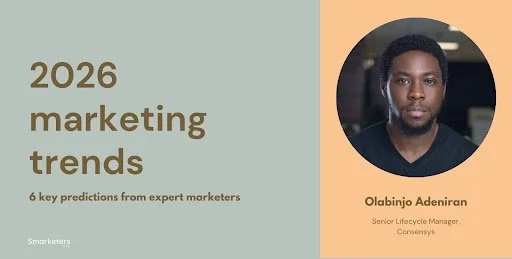
What marketing trends do you foresee in 2026?
I foresee B2C campaigns on LinkedIn. I think this is an underrated play that's been gearing up, and 2026 is the breakout year for B2C brands targeting LinkedIn personas. LinkedIn allows marketers to target ICPs based on industry, job title, years of experience, seniority, and location.
These are very useful for B2C brands who might be trying to reach a 'type' of person. LinkedIn is also pretty serious, and there's an opportunity to break the ice — brands can be more friendly, funny, and even sassy.
How to prepare for growth:
Reframe your thinking about LinkedIn: It's a great place to reach business leaders and professionals in SaaS, professional services, consulting, coaching, etc. But it's been overlooked by consumer brands because it is so serious. It's time to play and use LinkedIn creatively. Lots of professionals are looking for content that can help their daily lives, not just at work but outside of work as well.
3. More brands will lean on social marketing
Etashe Linto Okpola
What marketing trends do you foresee in 2026?
I see more brands doing more social-related marketing. Now, by social, I don't necessarily mean the use of social media, but the type of marketing that infuses brand identity, is social-leaning and community-focused. I see this happening in two ways.
One is through collaborating with influencers. An example of this is the American YouTuber, Ryan Trahan. He created a series this year called 50 Days in 50 States, where he traveled across all 50 states in America in 50 days. He gamified the entire concept by creating a structure for brands to donate. The higher a brand donates, the higher it places at the top of the leaderboard, giving it more visibility.
Lectric eBikes, a manufacturer of electric bikes, tapped into that marketing avenue. Essentially, they donated by showing up during the series and giving Ryan their bike, offering to donate $10K for every day he rode it.
There were 50 videos in total, posted daily like a series. Imagine the level of brand awareness Electric E-Bikes gained. Every day, he showed himself riding their bike and gave them a shout-out in each video. And if you check the leaderboard, they’re still at the top. They’re still one of the biggest donors.
Other brands also did interesting things in terms of social-based marketing, but what makes this stand out is how many aspects of selling it covers. It painted Electric E-Bikes as a brand that cares about a good cause. And because Ryan’s series was also a fundraiser, it showed them as a brand that cares about helping people in need.
The second way I see brands do social marketing is through social media itself, and this is a very subtle approach. It’s this thing where brands engage with other brands’ content, especially on platforms like TikTok. You’ll see brands showing up in comment sections, being very casual and very humorous about it.
A good example of this was Duolingo’s “Duo is dead” campaign in February. If you read the comments, you’ll notice that many companies were quick to join the conversation. They did this as a way to tap into the campaign’s popularity. And it worked especially for building brand recognition.
Brands are already doing this more and more. In fact, many of the things I’m seeing are probably not even “trends” anymore, but patterns that are becoming more common and will likely continue into next year.
How to prepare for growth:
Learn and adapt: Stay aware of what other companies are doing with marketing within and outside your industry. Obviously, marketing to Nigerians is very different from marketing in international spaces.
For instance, influencer marketing will look different compared to, say, the U.S, because value systems across these cultural regions vary. But marketing principles are, in many cases, the same. So, African marketers should be aware of these nuances as they adapt these ideas to their region, business, company goals, and specific audience.
4. Rise in employee-generated content
Lydia George
What marketing trends do you foresee in 2026?
We'll see more employee-generated content moving forward. Before now, companies often relied on influencers and creators to promote their brands. However, with the rise of the creative economy and the shift in how 9-to-5ers are turning into creators, employees are gradually becoming the face of the company. Audiences now associate people with places — the same way they associated Feranmi Ajetomobi with Cowrywise.
It’s always been that way to an extent, but now we’ll see a more content-driven approach in 2026 where employees become a major part of the conversation, especially on LinkedIn. It’s already happening in the West. Employees are being tied to the brands they represent, just like Grace Andrews is associated with The Diary of a CEO. And in the African context, a good example is Tamilore Oladipo from Buffer.
It’s the same way I believe employees are going to start driving a lot of recognition for the business. Basically, they’ll talk more about their work, especially on LinkedIn, and explain exactly what they do. Not the vague “oh, I’m doing great work” kind of thing, but why they did it and what it involved. They’ll start creating content around what they’re actually doing, and that will drive recognition for the brand within certain communities.
We’re already seeing this shift with companies leaning away from very polished content, although it hasn’t fully taken off here yet. It’s already happening in the West, and some companies in Nigeria are beginning to experiment with it. But I think by 2026, we’ll see more of this, where less polish becomes the new normal.
Unfortunately, Nigerians tend to catch on late. A lot of things goes through approvals, and once you show your boss content that isn’t heavily branded, it’s often an automatic no. But once leadership teams begin to see how well unrefined content performs on social media, I think we’ll see a lot less pushback from managers.
How to prepare for growth:
Build in public: Talking about your work is already the new normal, but not in a vague way like, “Hey, we did this.” Instead, create actual case studies around your work. Go beyond “I worked on this cool campaign” and explain all the steps it took to bring it to life. We’re going to see more marketers doing this. It boosts your personal brand and credibility, and it also benefits your workplace.
Execute with speed: As marketers we have to get faster with our ideas. You need to learn how to take content from recording to editing to execution as fast as possible.
Before, everyone wanted to create highly polished videos with fancy edits. Now, we need to distinguish between content that truly needs that level of editing and content that just needs simple text, a few edits, and to be moved out quickly. As social media managers, we need to execute a lot faster. Execution now has to be fast, great, and precise.
5. AI will become more accessible
John Iwuozor
What marketing trends do you foresee in 2026?
We might see AI become more accessible to marketers. The big enterprise tools will still be expensive, but affordable options should emerge. Just enough so African marketers can actually use AI without breaking the bank.
How African marketers can prepare for growth:
Be data-driven: If you're early in your career, focus on getting really good at understanding data. You don't need to be a data scientist, but you should be comfortable pulling insights from numbers and explaining what they mean. Start experimenting now, even with free tools like ChatGPT, Gemini, and Claude. Play around with them.
Develop AI literacy: Make AI literacy part of your skill set. Don't just use it, understand it. Know when it makes sense to use AI and when human judgment is better. It's gonna serve you in the long run.
6. Brand trust will drive visibility
Jessica Tee-Orika Owunna
What marketing trends do you foresee in 2026?
Visibility will depend more on how trusted you are across different platforms. AI tools and search engines already pull answers from many sources at once, and by 2026, it will be much harder to rely on SEO or one social channel alone.
As a marketer, you will need to build distributed brand trust by being seen as credible in search, on review sites, in niche Subreddits and communities, and on the channels buyers already go to ask questions.
How to prepare for growth:
Get close to real customers, not just trends on social media: Offer to help review sales call notes, customer chats, support tickets, or comments from WhatsApp groups and social pages. Turn what you learn into simple posts, threads, or case summaries. Share your work on LinkedIn, X, or local communities so people can see that you understand real problems, not just theory.
Create more content from proprietary sources: Rather than rely only on keyword tools, use what you already have around you: internal reports, customer interviews, sales feedback, and local market insights. Turn those into blogs, LinkedIn posts, WhatsApp newsletters, or simple reports that speak to how people actually buy in their own local markets.
Treat authority as a long-term growth lever, not a nice-to-have: Invest in original research, customer studies, or data stories that highlight how your buyers behave across African markets, then share them in places that carry weight for your audience. That could be local business publications, trade outlets, podcasts, community events, or regional conferences.
Repurpose these insights into content for LinkedIn, YouTube, and community platforms so your brand becomes the go-to voice in your category, both in Africa and globally. Beyond attracting leads, this also makes it easier to attract better roles, speaking invites, and cross-border opportunities.
💡 Read: Career lessons from Jessica Tee Orika-Owunna, BOFU & Product-led Content Specialist
Takeaways for 2026:
Marketing in 2026 won’t be about chasing every shiny trend. So try not to.
Across all six perspectives, it’s clear that the future of marketing is about being adaptable, credible, relevant, and building human connections in an AI-focused world.
So before you adopt the next big trend, pause and ask: Does this align with my audience, my market, and the real problem I’m solving? Trends may fade, platforms may shift, and algorithms may change, and user behaviors will evolve. But if you prioritize clarity, authenticity, and long-term value, you’ll stay on track.
If you want a clearer roadmap of what marketing could look like in 2026 and how to position yourself for growth, join us for “The Marketing Playbook 2026: Positioning, Profiting & Growth” virtual event we’re hosting.
On November 28th, we’ll bring together senior marketers, including Jessica Tee Orika-Owunna, Folasade Daini, Bolaji Anifowose, and Oyinkansola Ogunyinka Edem, who will unpack emerging shifts, share deeper insights, and actionable strategies to help you prepare for what’s coming.