
It’s almost cliché to repeat the often-touted phrase: “The majority of your customers are online”. It’s not hype; the past 10-15 years have changed how consumers interact with brands. Now, the average Joe goes online to research, read reviews and seek out content before making a purchase.
How does this concern you, though?
In the past few years, the tides have shifted. Brands aren’t only seeking customers through ads or other traditional marketing methods. Instead, they actively position themselves online so that searchers, i.e. potential customers, can find them.
How can you do this? Two words— “inbound marketing”.
When combined with SEO analysis, inbound marketing makes your brand visible to the right audience. When you take it all the way, your customers will troop in like ants to a sugar field.
In this article, we will discuss exactly how to combine these two ideas to get the real results that your brand needs.
Table of contents
What is inbound marketing?
Imagine you had a cookie business and then realized you weren’t making as many sales or attracting any new customers. So, you create a discount offer and run ads on social media. Let’s say you even top it off with a jingle on your local radio station. That is precisely what inbound marketing is NOT.
Now, imagine the same scenario, but instead of broadcasting your offer everywhere, you decide to hold a beginner's baking class. You make it very valuable for everyone who attends, and eventually get new customers and prospects. Now, THAT is inbound marketing.
Inbound marketing strategy
An inbound marketing strategy focuses on hooking your customers through valuable content related to your business. Think webinars, ebooks, social media updates, podcasts, blog posts, etc. The key distinction in inbound marketing is that it doesn’t interrupt a target’s online experience but aligns with their needs and goals.
Core elements of an Inbound marketing strategy
Here are three elements of a good inbound marketing strategy you should know:
1. Content creation
Content is usually seen as the “fuel” for an inbound marketing engine. Blogs, guides, videos, and webinars are all types of content that can be created and shared across social media platforms and the brand’s websites.
2. Search engine optimization
Content that is not discoverable won’t contribute to the brand’s goals. Optimizing content for search engines ensures that it isn’t hidden and can generate inbound leads for you.
3. Lead nurturing
You need to build trust and authenticity with the website visitors who have shown interest but haven’t converted to customers. Email marketing is usually one of the best ways to do this.
The 4 stages of inbound marketing
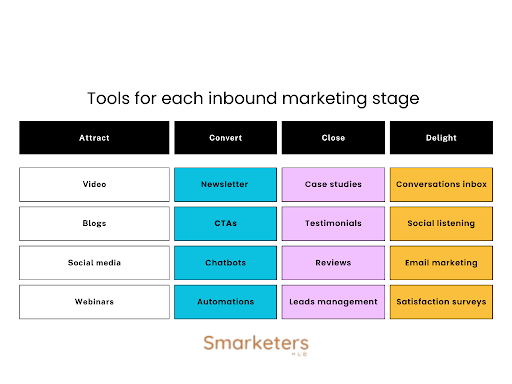
Inbound marketing happens in 4 stages: attract, convert, close, delight. Let’s go a little deeper into each stage.
1. Attract
This stage of inbound marketing attracts new users to your website through content. The content you create can be entertaining, educational, or informative. But it must be relevant to your audience. You don't want to attract every Tom, Dick and Harry to your brand’s website. Your audience must be the right people who can become leads and eventually, paying customers.
So at this stage, you should ask yourself some important questions:
Who’s my ideal customer?
What do they want/need?
Where do they hang out online?
How can I provide value to them?
Which content format will they respond to best?
💡 Read also: How to create content for every stage of the buyer’s journey
2. Convert
At this stage, your efforts are going into converting your traffic into qualified leads.
A new user who’s attracted to your website becomes a lead when they engage with your site and share some of their information with you. The content you create at this stage should highlight the benefits of your solution and how you solve problems.
Try not to focus on your product or its features. You want to build trust and a long-term relationship with your leads.
There are many ways to collect their information:
Lead capture forms
Demo calls
Newsletter subscription pop-ups
Chatbots
Understand your users’ behaviour and what they would rather interact with. Integrate that into your website and capture these leads as soon as they come in.
💡 Pro tip: Include CTAs that seamlessly ask for contact details. A good example is how at Smarketers Hub, some of the CTAs on our website direct incoming traffic to either join our community, subscribe to our newsletter or purchase one of our resources.
Our blogs always carry one of these CTAs as well. Almost effortlessly, we can consistently convert our traffic to qualified leads.

3. Close
This is the stage where you convert a lead into a paying or subscribed customer.
Any customer at this stage is well into the consideration phase of their buying journey. What you need to do is follow up with content that persuades them to take the final step or deliver exceptional customer service.
A comparison blog, a case study or a testimonial are great examples of content that can move your website visitor from lead to buyer.
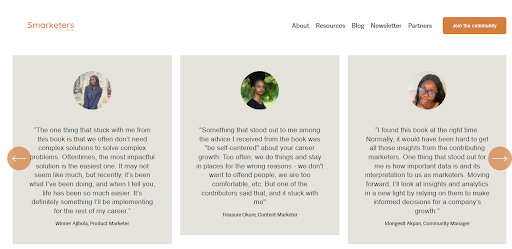
“What Readers are Saying” section of the Inside the Marketers Room product page
Delight
At this stage, think about how to support and cater to your customer even after purchase.
Your aim at this stage is to turn each customer into a repeat buyer and brand promoter. This is important because acquiring a new customer can cost as much as 5 to 25 times more than retaining an existing one.
Your strategy here can incorporate social media listening to discover and solve problems your customers have while/after using your product. You can also conduct a satisfaction survey or ask for feedback at different touchpoints during your customer’s journey.
Your reputation is critical to your growth, so don’t spare anything when it comes to delighting your users (even when there’s no direct value to your business). A happy and satisfied customer is a brand promoter.
What is SEO analysis?
Search engine optimization is the foundation of inbound marketing. It’s the primary way new users can find your brand’s website. You must have a working SEO strategy as this determines your website’s ranking on a search engine’s results page.
By extension, SEO analysis involves reviewing and evaluating your website’s search performance. It’s an audit process that lets you identify your website’s strengths, weaknesses, and gaps to improve its SERP ranking and search traffic.
Components of an SEO analysis
The following are the elements to audit when carrying out an SEO analysis:
1. On-page SEO
This involves reviewing the content on your site: keywords, meta descriptions, images, etc. Do they meet Google’s EEAT (Experience, Expertise, Authoritativeness, and Trustworthiness) requirement?
2. Off-page SEO
These are the things not on your site but can still help build trust with the search engine. A key element of off-page SEO is backlinks.
You need to audit the number of links from other sites (websites or social media) that lead to yours. More backlinks indicate that other websites find your content valuable and authoritative.
3. Technical SEO
These are behind-the-scenes elements that improve a user’s experience on your website. Some of the things to audit are: site speed, mobile friendliness, navigation, sitemap, etc. Your website content should be easily scannable and readable by Google’s crawlers. This, in turn, will ensure that your content appears to searchers.
How does SEO analysis impact inbound marketing?
An SEO analysis will provide direction to your inbound marketing efforts.
It helps you recognize the content that works (so you can optimize), the keywords that matter to your audience and opportunities you can explore. This will help you create valuable content for your audience, attract the right people and convert them into leads.
6 steps to combine SEO and inbound marketing for your brand
1. Run a website audit
This will help you determine where your website stands right now. Again, analyzing on-page, off-page and technical SEO will give you insight into your site.
2. Research keywords
There are several methods and tools for this. Try using a combination of social media and keyword research tools to get this done.
Use social media to gather insights on the conversations your target audience is having relating to your niche. Extract topics from there and use a keyword research tool (e.g. Google Keyword Planner, SEMrush) to find related keywords.
3. Map keywords to content
Integrate these keywords into a solid content strategy.
Rejoice Ojiaku shares, “You can use AI at this stage to cluster your keywords into overarching topics and subtopics. You can even go a step further and ask AI to help you think about the best content format for this key term”.
Content formats can vary from blogs, guides, videos, webinars, etc.
4. Optimize for technical SEO
Remember, your website’s technical SEO is critical for Google’s crawlers and the experience of new users. Ask yourself:
Is the content on our website mobile-friendly?
Do the images load quickly?
Is it easy to navigate?
It’s not enough to have strong keywords; your website shouldn’t stress users.
5. Promote through inbound channels
Share your website across the community you already have. Make your website memorable and link to it in your emails, social media bios, communities, videos, etc.

Source: X
Search engine optimization is not a one-off business. Revisit your website’s SEO analytics monthly to understand how your upgrades have improved your website’s rankings and spot what’s not working.
Final thoughts
SEO analysis shows you where to focus your SEO efforts, and inbound marketing applies those insights to help you create valuable content that converts.
Having a successful inbound marketing strategy goes beyond brainstorming content and executing. There’s a method to understanding your target audience and making your content invaluable to them. However, without a foundational understanding of SEO, you might as well cover your content with an invisibility cloak. It won’t rank on the SERPs, so only very few people will see it, resulting in minimal conversion.
If your SEO efforts haven’t been paying off, you need to analyze your strategy to determine whether you’re taking the right measures and/or focusing on the right metrics.
At Smarketers Hub, we created a masterclass that takes you on an analytics deep dive across content, product, and social media. Our instructors are experts who have applied analytics in real business contexts, from building systems to influencing product and growth decisions.
Get the analytics masterclass video and you’ll be able to access:
Templates & checklists
Instructor slide decks
Access to our analytics resource library